Solution Overview

FTTR Cabling Solution

In the digital economy era, as a large number of new applications emerge, problems such as slow internet speeds and weak signals are becoming increasingly common in everyday network use. Fiber-to-the-Home (FTTH) is now widely deployed for home broadband; however, when users demand higher bandwidth, this approach also has shortcomings such as the limitations of network cables and poor WIFI wall-penetration capability, leaving the actual speeds of terminal devices below the expected rates.

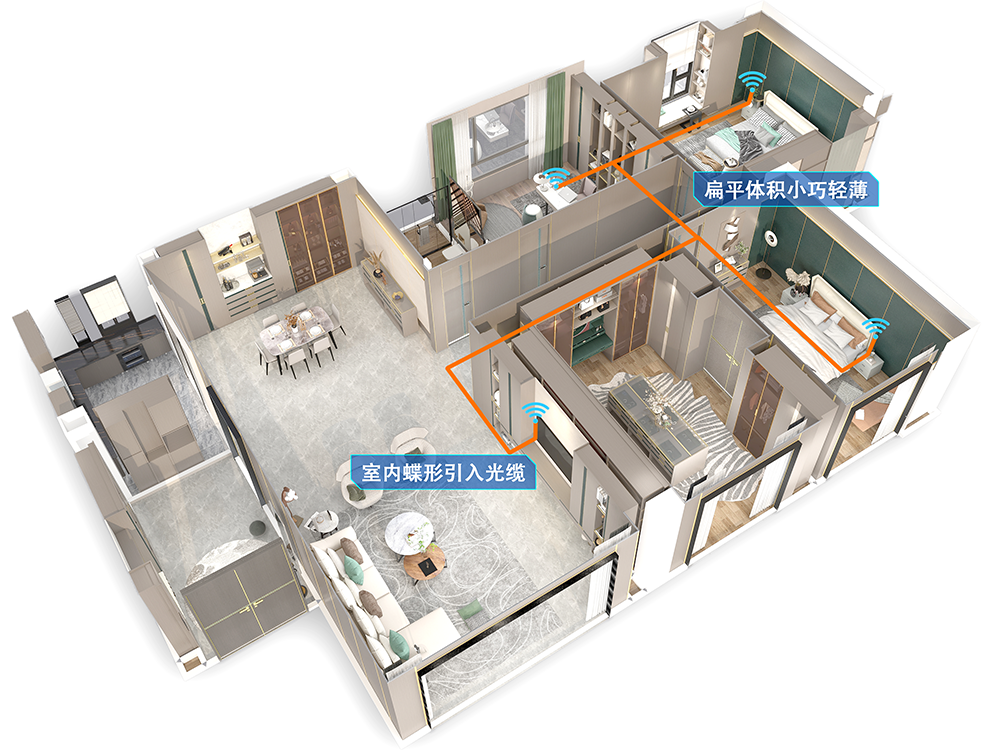
To address these issues, the FTTH upgrade solution FTTR has emerged. Its core concept is to bring optical fiber into every room, with master and slave ONTs connected by a single optical fiber to achieve high-speed coverage throughout the home. Using optical fiber transmission, it is laid once and delivers long-term performance.

Free Consultation Hotline 400-087-8778

Solution Architecture

FTTR Networking Architecture

Master-Slave Device Architecture

The solution adopts a master ONT + slave ONT all-optical networking architecture, using the master optical network terminal at the premises as the core signal source and daisy-chaining slave node devices in each room through dedicated indoor fiber links. Discarding traditional twisted-pair transmission, it achieves full coverage from the signal source, with every room capable of independently delivering high-speed, stable network signals.

Whole-Home Fiber Cabling Mode

Fiber is innovatively extended to outlets in every room, achieving deep fiber-to-the-room coverage. With all-optical transmission and no intermediate loss, a single fiber can simultaneously carry network data, wireless coverage, smart device connectivity, and other services, making the networking structure simple and efficient.

Construction and Iteration Characteristics

One-Time Cabling for Long-Term Use

Indoor fiber optic cable is made of materials resistant to aging and interference with extremely low loss; once installed, it can serve stably for years without frequent replacement, thoroughly solving the problems of traditional copper cabling, which is prone to aging, attenuation, and periodic renovation.

Smooth Upgrade and Compatible Adaptation

Built on mature fiber access standards, the solution is fully compatible with existing carrier FTTH resources; without modifying outdoor trunk lines, it only optimizes indoor transmission links, enabling smooth migration between old and new network systems and suiting network upgrades in homes and small commercial spaces.

Applicable Coverage Scenarios

Whole-Home Residential Networking Scenarios

Suited to all types of family residences such as large flat layouts, duplex apartments, and multi-story villas, it solves the weak WiFi signals, uneven speeds, and dead-zone disconnections caused by multiple wall obstructions, meeting home high-speed network needs for whole-home smart devices, remote work, audio-visual entertainment, online classes, and live streaming.

Small Commercial Office Scenarios

Applicable to lightweight commercial spaces such as small studios, street-front shops, and homestay apartments, it provides stable concurrent internet access for multiple terminals, avoiding the shortcomings of traditional twisted-pair networking, namely insufficient bandwidth, heavy interference, and burdensome O&M, and suits lightweight high-speed networking projects.

Solution Advantages

01 Ultimate Transmission Performance
02 Whole-Home Coverage with No Dead Zones
03 Higher Long-Term Cost-Effectiveness
04 Strong Scalability and Compatibility
End-to-end fiber transmission is free of electromagnetic interference and signal attenuation, breaking through the bandwidth limits of traditional copper cabling to fully release in-home bandwidth resources, delivering consistent whole-home speeds, low latency, and zero stutter for greatly improved network transmission quality.
Master-slave ONTs linked over fiber provide independent signal output in multiple rooms, thoroughly solving the industry pain points of weak wall-penetrating WiFi and signal dead zones to deliver uniform, high-strength network coverage throughout the home.
Fiber optic cables far outlast ordinary copper Ethernet cables - a single installation serves for life without repeated retrofits or upgrades, dramatically reducing the time and capital costs of later network maintenance and cable replacement.
The all-fiber architecture reserves ample bandwidth headroom to support future 10G broadband upgrades and whole-home smart device expansion, while remaining compatible with various wireless terminals and smart hardware to meet the needs of future digital living.