Solution Overview

AI Switch & Storage Solution

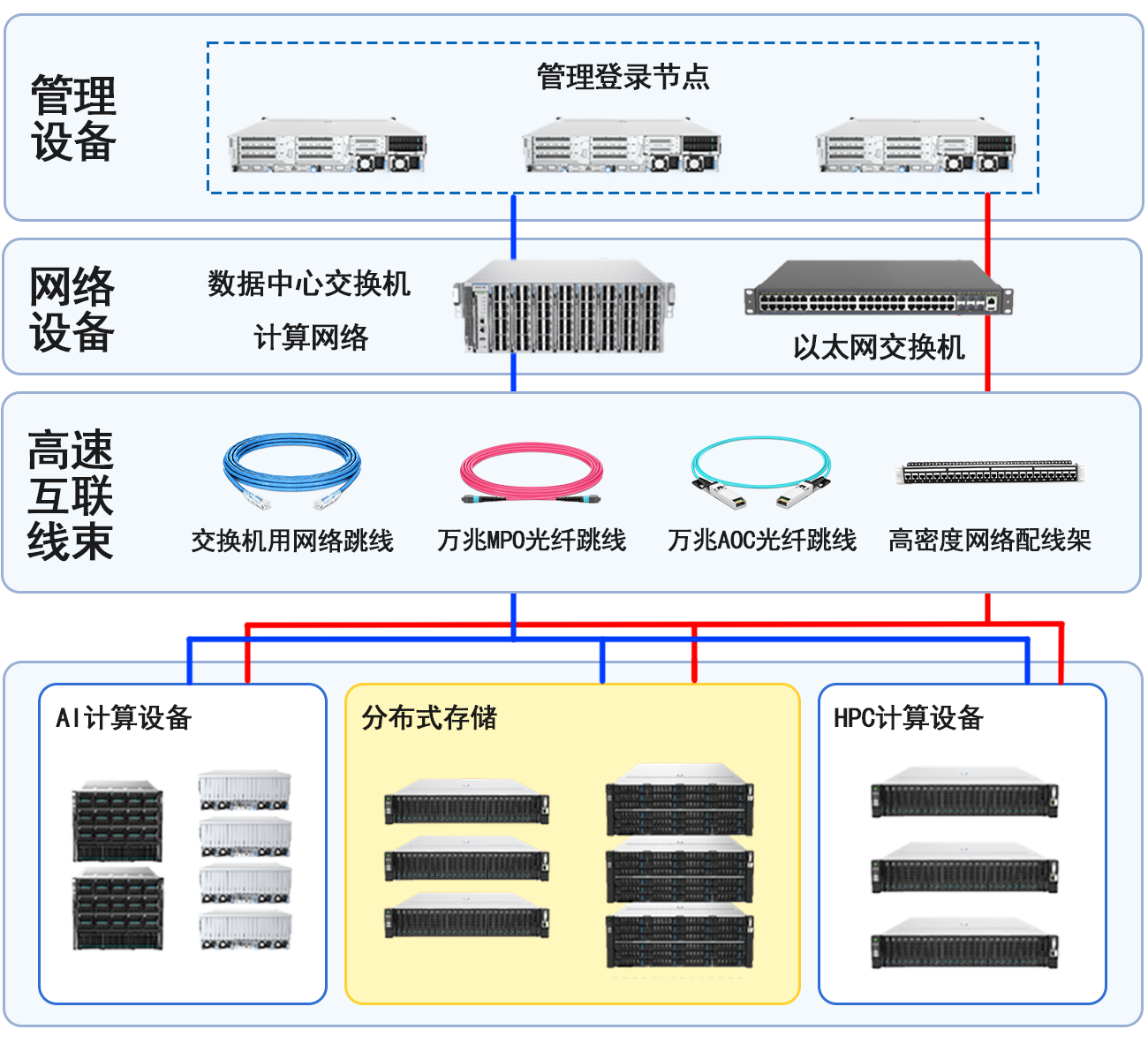
AI compute clusters generate enormous data interchange traffic. MPO pre-terminated fiber, factory pre-fabricated to standardized specifications, delivers stable insertion loss and rapid installation, while multi-fiber high-density cables greatly reduce rack cabling footprint and improve equipment heat dissipation. The centralized trunk interconnection architecture simplifies links and reduces connector failure points, and supports 100G/400G/800G high-speed modules to meet the high-throughput interconnection demands of compute servers and storage pools. As the AI industry keeps expanding and supercomputing centers and AI computing rooms are being built in volume, demand for high-density cabling is surging. With its easy scalability, simple maintenance and modular upgrade path, MPO pre-terminated fiber has become the mainstream cabling choice for AI projects, with promising long-term market prospects.

Free Consultation Hotline 400-087-8778

Solution Architecture

Solution Standards and Transmission Characteristics

Prefabricated Link Performance Advantages

This AI computing and storage cabling solution uses an MPO pre-terminated fiber system in which all cables and connectors are precision-prefabricated by factory automation and pass optical testing before shipment, yielding stable, consistent insertion loss values and completely avoiding problems such as high loss and inconsistent quality from on-site splicing and hand termination. The complete link delivers high transmission precision and extremely low bit error rates, perfectly matching the stringent transmission requirements of AI computing clusters for ultra-large traffic and high-density data exchange, ensuring real-time throughput of massive computing data.

Ultra-High-Speed Bandwidth Compatibility

The system natively supports the full range of 100G, 400G, and 800G high-speed optical modules, with ample bandwidth headroom and exceptional link throughput, satisfying high-frequency, massive data synchronization and concurrent exchange between computing server clusters and distributed storage pools. It solves the bandwidth shortfalls and forwarding bottlenecks of traditional cabling and suits the rapid iteration demands of AI supercomputing and intelligent computing services.

Networking Architecture and Cabling Design

High-Density Compact Cabling Architecture

The multi-fiber integrated MPO fiber networking structure greatly increases cabinet port density over traditional single-fiber cabling, significantly saving internal cabinet space and tray resources and reducing redundant cable buildup. It effectively improves ventilation and heat dissipation in the equipment room and lowers the risk of device throttling and faults caused by heat accumulation.

Trunk Centralized Interconnection Mode

A core trunk centralized interconnection architecture is used overall, simplifying multi-tier link structures in the equipment room and reducing intermediate transition points and connector fault points. The clean, orderly link structure not only improves network-wide transmission stability but also greatly reduces later O&M troubleshooting effort, suiting large-scale deployment of massive computing clusters.

Project Applicable Scenarios

Premium Computing Facility Scenarios

Dedicated to premium computing infrastructure projects such as AI intelligent computing centers, supercomputing centers, and large cloud computing facilities, it suits high-density interconnection between computing server clusters, centralized storage pools, and high-speed core switching equipment.

Industry Expansion and Construction Scenarios

Suited to the current large-scale expansion of the AI industry and to batch construction, expansion, and upgrade projects of computing facilities, it addresses the high-density, high-throughput, fast-iteration characteristics of computing rooms and satisfies engineering needs for modular construction, phased expansion, and rapid go-live.

Solution Advantages

01 Ultra-Low-Latency Links
02 Easy Rework and Expansion
03 High-Density Cabling
AI computing workloads are characterized by massive data exchange and instantaneous traffic bursts, demanding extremely low latency and ultra-high throughput from links, which must support stable high-speed transmission of 10G and above to reduce data latency and packet loss in model training and compute scheduling. MPO pre-terminated 10G optical fiber uses precision factory pre-termination technology, featuring low insertion loss and stable transmission performance that perfectly suits high-speed compute-cluster links. Its high-density multi-fiber structure streamlines cabling, reduces link failure points, and optimizes data center cooling, while supporting modular rapid expansion to efficiently meet the ever-escalating transmission demands of AI computing.
AI computing room services iterate rapidly and equipment is expanded frequently. Traditional fusion-spliced cabling is difficult and time-consuming to rework and prone to damaging links. MPO pre-terminated fiber adopts a modular pre-fabricated architecture that requires no on-site fusion splicing, so subsequent rework, commissioning, and migration involve no changes to the backbone trunk cable. Bandwidth upgrades and port expansion can be completed simply by replacing branch patch cords — zero destructive work and short construction periods, greatly reducing retrofit risks and O&M costs. Standardized interfaces provide strong compatibility, allowing smooth upgrades to 100G/400G/800G high-speed links and perfectly matching the continuous iteration and dynamic expansion requirements of AI compute clusters.
AI computing rooms are densely packed with equipment and enormous numbers of optical paths, making traditional LC single-fiber cabling bulky and space-consuming. With its integrated multi-fiber, high-density structure, MPO pre-terminated fiber greatly reduces cabling footprint, effectively saving space in cabinets, cable trays, and routing channels. The streamlined cabling system reduces cable stacking, improves ventilation and heat dissipation in the data center, and lowers link failures caused by high temperatures. Meanwhile, well-organized cabling reduces line interference and failure points, enhancing link stability, supporting dense deployment of large-scale server and storage clusters in intelligent computing centers, and enabling high-density expansion of compute equipment.