Solution Overview

Enterprise Cabling Solution

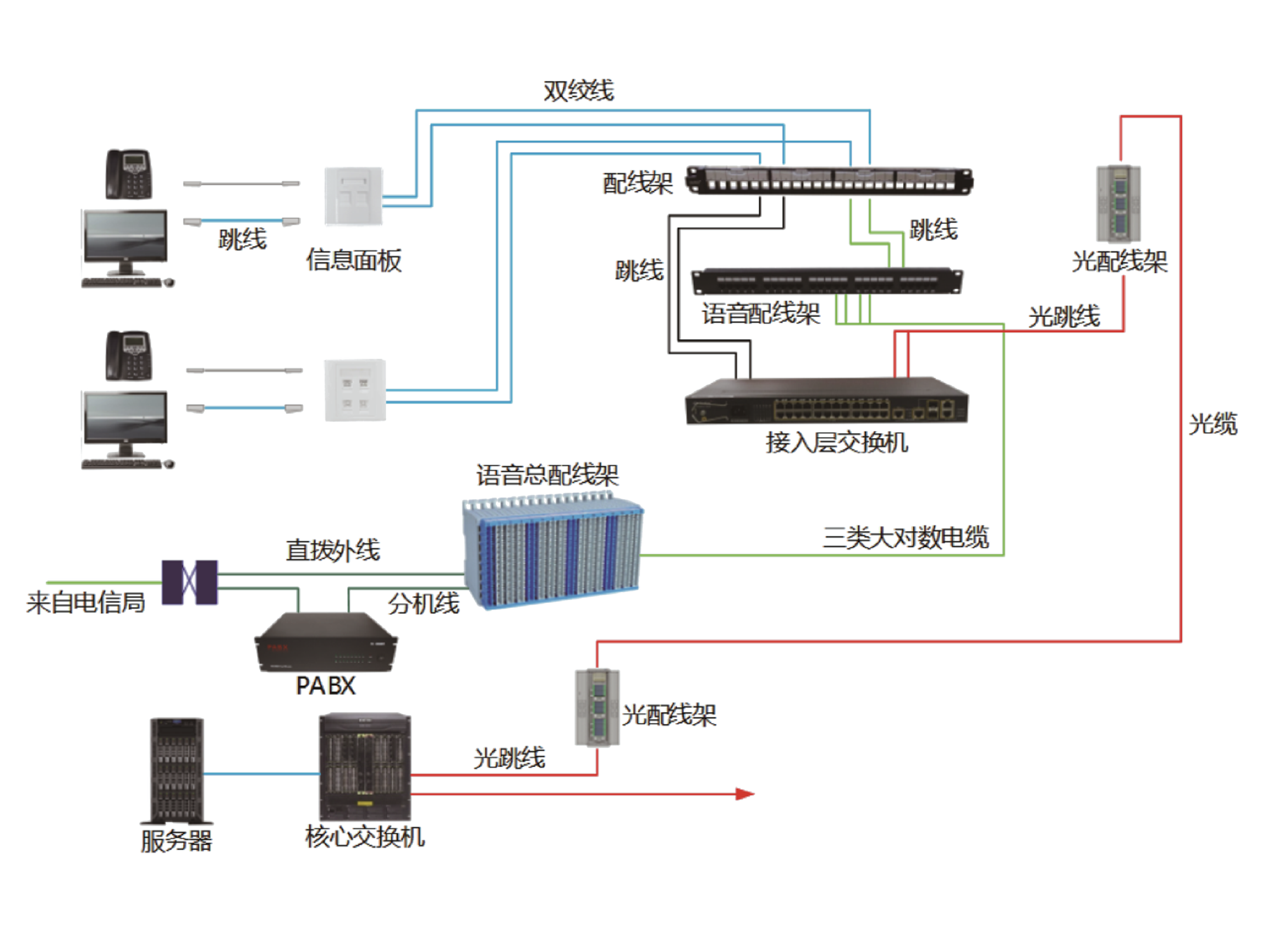
This solution adopts a three-tier structured cabling architecture of fiber backbone + horizontal twisted-pair cables + voice multipair cables. The backbone uses multimode fiber and patch cords to ensure stable high-bandwidth transmission; Cat5e/Cat6 cables and patch cords at the horizontal tier deliver data access; voice services are connected to the PABX via multipair cables working with patch panels. Data and voice lines are physically separated, balancing stability, ease of installation and scalability, and suiting scenarios such as enterprise data office work, voice communications and server operations.

Free Consultation Hotline 400-087-8778

Solution Architecture

Hierarchical Cabling Architecture

Core Backbone Layer

Multimode fiber is used as the main trunk transmission medium in the equipment room, paired with fiber patch cords to connect core switches and aggregation devices, achieving low-loss, high-bandwidth transmission that carries high-capacity data exchange between server clusters.

Data Access Layer

Category 5e and Category 6 twisted-pair cabling is deployed throughout the office area, covering workstations and meeting room terminals, with high- and low-bandwidth outlets differentiated to meet all data access needs such as daily office work and HD conferencing.

Voice Communication Layer

Large-pair-count voice cables are laid and connected via patch panels to enterprise PABX telephone exchanges, building an independent voice channel physically isolated from data lines to eliminate call noise.

Hardware and Cable Selection

Fiber Optic Accessories

OM4 multimode fiber is used for the backbone, paired with LC fiber patch cords, suited to short-distance 10G transmission in the equipment room, providing stable transmission and strong immunity to electromagnetic interference.

Copper Network Cabling

Category 6 cabling is used at high-bandwidth outlets such as design and conference rooms, while Category 5e cabling is deployed at regular office workstations, matched as needed to balance construction costs.

Construction and Acceptance Standards

Cabling Construction Specifications

Data and voice conduits are laid strictly separated, routing avoids power cable trays, and all lines are labeled with identification tags for easy maintenance and distinction later.

Link Testing and Acceptance

After construction, professional tools are used to test fiber loss and cable crosstalk indicators, continuity testing is performed at all outlets, and delivery is completed only after full-load operation runs without lag.

Operation, Maintenance and Future Expansion

Daily Operation and Maintenance Assurance

The hierarchical, zone-based cabling structure enables rapid fault localization; fiber optic connectors are cleaned regularly to reduce network performance degradation caused by cable aging and contamination.

Expansion and Upgrade Capability

Redundant outlets are reserved in conduits and patch panels, so future workstations and equipment room devices only require extending end links without rebuilding the backbone architecture.

Solution Advantages

01 Excellent Transmission Performance
02 Reasonable Product Mix
03 Secure and Reliable Links
04 Easy Expansion and Maintenance
The core backbone is built with indoor multimode fiber, multimode fiber patch cords, and MPO patch cords, delivering high bandwidth and strong interference resistance. It provides a high-speed, low-latency backbone link for core switches, servers, and access-layer devices, supporting high-concurrency enterprise data services and a dual external network redundancy architecture to ensure uninterrupted operation of core services.
Cables are selected according to scenario differences: regular outlets use Cat 5 cables and patch cords to control costs, while high-speed office outlets deploy Cat 6 cables and patch cords to guarantee gigabit transmission. The fiber series products set a solid performance baseline for the backbone network, and the complete combination balances user experience with total cost, delivering outstanding cost-effectiveness.
A layered architecture of fiber plus twisted pair provides physical isolation between multiple services, effectively avoiding signal interference. Backbone links support redundant design and, combined with a full line of standardized cables and patch cords, keep connections solid, greatly reducing the probability of network faults and ensuring continuous enterprise operations.
All network cables, fiber, and patch cords are industry-standard products with strong device compatibility. The overall cabling architecture reserves ample bandwidth and outlet space, so adding workstations, upgrading equipment, or expanding business later requires no major renovation, making installation and daily operations and maintenance simple and efficient.