Solution Overview

Campus Cabling Solution

With classroom digital devices multiplying and the comprehensive upgrade to Wi‑Fi6, campuses face pressure from insufficient ports and rising bandwidth and cabling standards. Moreover, the intricate, multi-tiered structure of traditional networks makes new service deployment cumbersome and fault diagnosis difficult. The numerous scattered equipment rooms carry heavy O&M burdens and fire-safety risks, while the sheer volume of legacy copper cables crowds cable trays and ages rapidly. An all-optical network, by contrast, requires only a few optical fibers with a service life of 20 to 30 years, which is far better suited to today's needs.
Free Consultation Hotline 400-087-8778

Solution Architecture

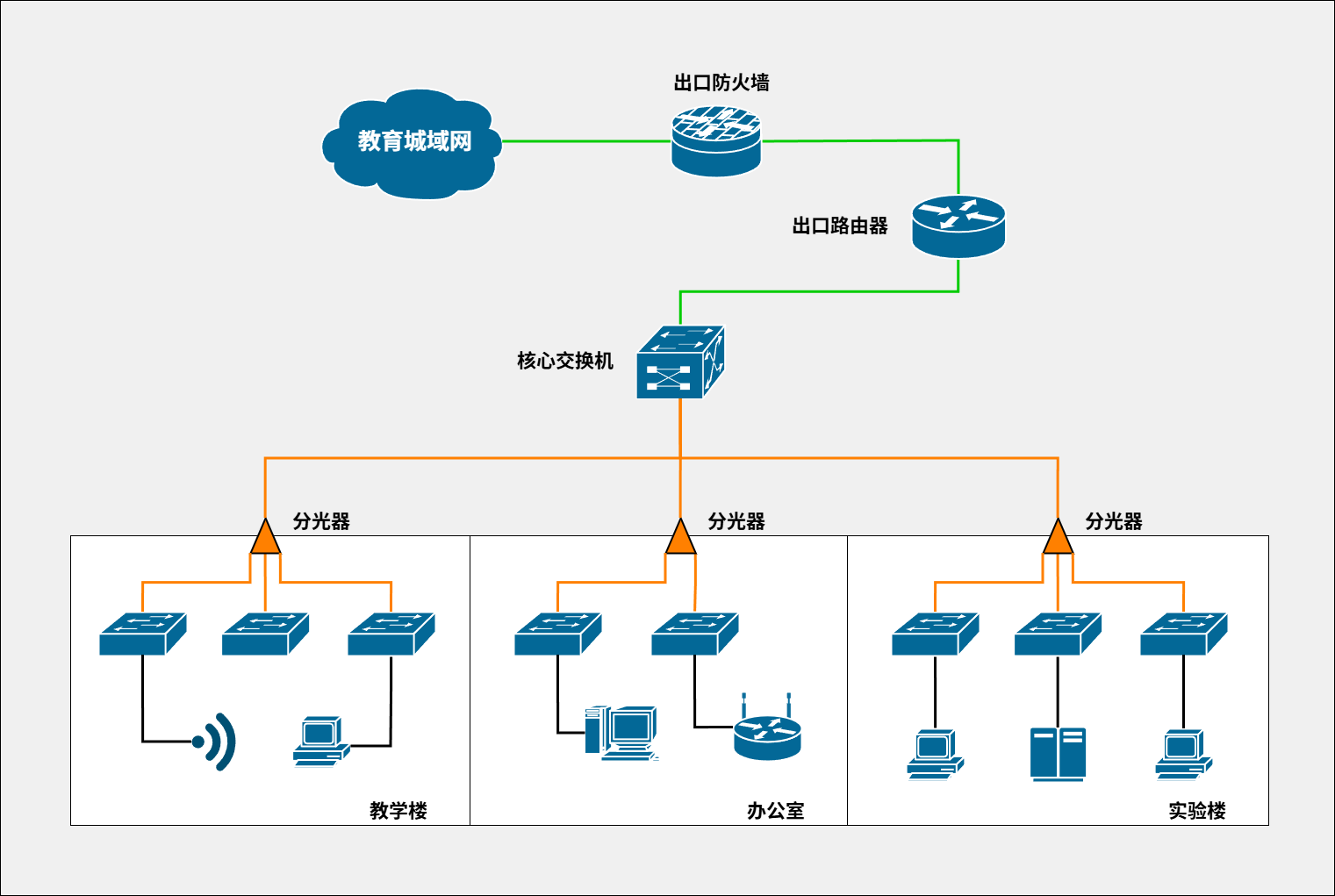
Campus Cabling Architecture Design

Core Equipment Room Layer

Single-mode fiber is used to build campus-wide backbone links, carrying data forwarding from aggregation devices in teaching buildings and dormitories, with high bandwidth supporting campus-wide Wi-Fi 6 and concurrent access from multimedia classrooms.

Building Aggregation Layer

Optical distribution boxes are deployed in the ELV rooms of each building, downlinking to classroom outlets via OM4 multimode fiber, simplifying intermediate tiers and reducing ELV room maintenance and fire hazards.

Classroom Access Layer

Classrooms adopt lightweight fiber-to-the-room access to replace the traditional mass of twisted-pair cabling; a single fiber can carry multiple IT devices, freeing up cable tray space and slowing line aging.

Cable and Hardware Selection

Backbone Fiber

OS2 single-mode fiber is used for long-distance transmission from the equipment room to each building, with low transmission loss, suited to large-scale campus networking across buildings.

Access Fiber

Classroom outlets use drop fiber optic cable, which occupies little space during routing and has a service life of 20 to 30 years, eliminating the need for frequent cable replacement over the long term.

Supporting Equipment

Paired with Wi-Fi 6 optical-port APs and fiber optic patch panels, a small number of fibers can satisfy the multi-device port demands of multimedia teaching and wireless coverage.

Construction and O&M Assurance

Cabling Construction Specifications

Fiber is laid in dedicated cable trays, separated from power conduits, reducing the total cable volume and mitigating fire risks caused by line accumulation in ELV rooms.

Link Testing and Acceptance

Upon completion, fiber attenuation and wireless concurrent throughput are tested to ensure multiple devices in classrooms stay online simultaneously without lag and with stable network performance.

Later Operation, Maintenance and Expansion

The streamlined architecture enables rapid fault location down to building and classroom level; redundant fiber is reserved so future teaching equipment additions require no backbone rebuild.

Solution Advantages

01 Improved Fire Safety
02 Lower Long-Term Costs
03 Simplified Operations and Maintenance
04 Ample Bandwidth for Easy Expansion
All-optical cabling uses fewer cables, greatly saving cable tray space and preventing cable accumulation, reducing fire risks in campus telecom rooms
Fiber optic cables can last 20 to 30 years, reducing long-term investment in cable replacement and re-cabling renovations
A streamlined network hierarchy makes fault location simple, easing the daily operations and maintenance burden of dispersed telecom rooms across multiple buildings
High-bandwidth fiber backbone perfectly matches Wi-Fi 6 and multimedia teaching devices, resolving classroom port shortages and bandwidth bottlenecks