


With the rapid development of the Internet, demand for network address resources continues to grow. IPv4 (Internet Protocol version 4), the Internet's primary communication protocol, can no longer satisfy the ever-increasing demand for addresses. As a result, IPv6 (Internet Protocol version 6) has emerged as the mainstream choice for the next-generation Internet protocol. This article takes an in-depth look at the differences between IPv4 and IPv6, analyzes why the Internet needs a new addressing system, and explores IPv6's future development trends.
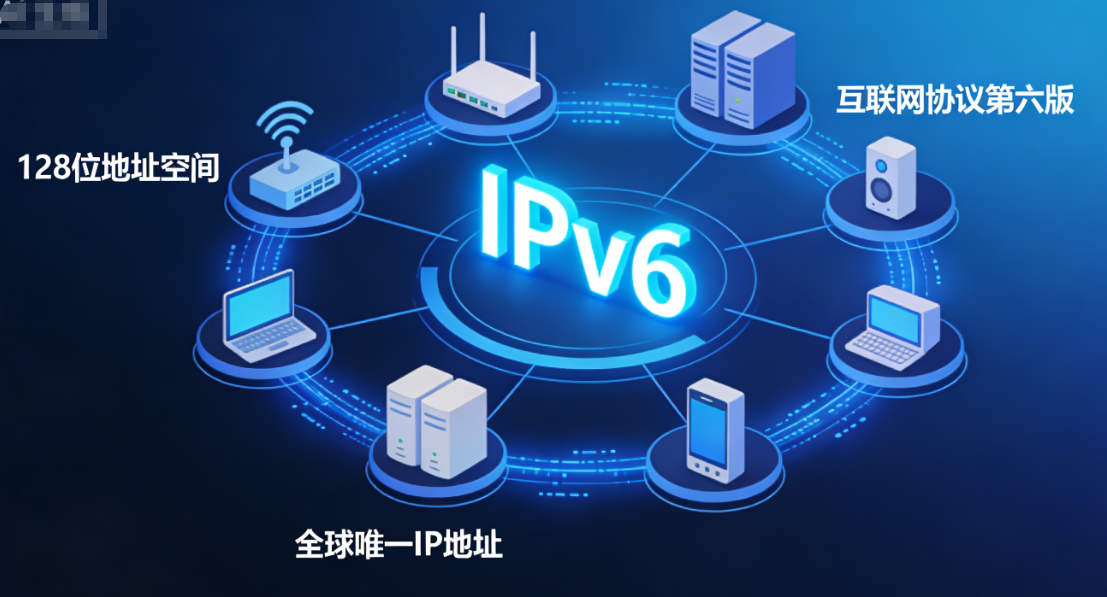
IPv4 is the fourth version of the Internet Protocol and has been a core Internet protocol since the 1980s. An IPv4 address consists of 32 binary bits, usually expressed in dotted-decimal notation, such as 192.168.1.1. This addressing structure divides network devices worldwide into different classes, such as Class A, Class B, and Class C addresses.
IPv4 has played an important role in the development of the Internet. It is simple, easy to use, and highly compatible, supporting a wide range of network devices and applications. In addition, IPv4 is widely deployed in various network environments, including LANs, WANs, and the Internet.
Although IPv4 has played an important role in the development of the Internet, it also has clear limitations. With the proliferation of the Internet and the growing number of devices, IPv4 address resources have gradually been exhausted. It is estimated that there are approximately 4.3 billion IPv4 addresses in total. However, with the popularity of smartphones, IoT devices, and smart home products, the number of network devices worldwide far exceeds IPv4's capacity.
In addition, IPv4 has shortcomings in security. It lacks built-in security mechanisms and is vulnerable to cyberattacks and data breaches. As cybersecurity concerns become increasingly prominent, these shortcomings are gradually becoming a bottleneck constraining the Internet's development.
IPv6 is the sixth version of the Internet Protocol, designed to solve the problem of IPv4 address exhaustion. An IPv6 address consists of 128 binary bits, usually expressed as eight groups of four hexadecimal digits, such as 2001:0db8:85a3:0000:0000:8a2e:0370:7334. This addressing structure dramatically expands the address space and supports many more network devices.
Vast address space:IPv6's address space is 2 to the 96th power times that of IPv4, providing almost unlimited address resources. This allows every device to have a unique global address, eliminating the need for private addresses and Network Address Translation (NAT).
Support for more devices:With the proliferation of IoT and smart home devices, the number of network devices is growing explosively. IPv6 can support connections from these devices, ensuring that every device gets sufficient address resources.
Enhanced security:IPv6 has a built-in IPsec (Internet Protocol Security) mechanism, providing stronger data encryption and authentication capabilities. This makes IPv6 networks more secure than IPv4 networks.
Performance optimization:IPv6 simplifies the packet header structure, improving data transmission efficiency. In addition, IPv6 supports multicast and anycast, helping to optimize network traffic.
Despite its many advantages, global IPv6 deployment still faces challenges. As of 2025, the global IPv6 deployment rate is approximately 35%. In some developed countries, such as the United States and Germany, deployment rates are higher, reaching 70% and 60% respectively. In some developing countries, however, IPv6 deployment rates remain low.
Dual-stack is a common approach to IPv4 and IPv6 coexistence. In this approach, network devices support both IPv4 and IPv6 protocols simultaneously. Dual-stack allows IPv4 and IPv6 devices to communicate with each other, but requires additional configuration and management.
Tunneling is another approach to IPv4 and IPv6 coexistence. By creating IPv6 tunnels over IPv4 networks, IPv6 packets can travel across IPv4 networks. Tunneling is simple and easy to use, but it may introduce additional latency and management complexity.
Address translation technologies such as NAT64 allow IPv6 devices to communicate with IPv4 devices. NAT64 enables interoperability between the two protocols by translating between IPv6 and IPv4 addresses. However, address translation can cause performance degradation and compatibility issues.
The exhaustion of IPv4 address resources is one of the main reasons the Internet needs a new addressing system. With the proliferation of the Internet and the growing number of devices, IPv4 addresses can no longer meet demand. IPv6's address space is 2 to the 96th power times that of IPv4, providing almost unlimited address resources. This makes IPv6 the ideal solution to the shortage of address resources.
The Internet of Things (IoT) is a new trend in Internet development, with the number of IoT devices worldwide expected to reach 50 billion by 2030. These devices need a vast number of network addresses for connectivity and communication. IPv6's address space can support connections from these devices, ensuring that every device gets a unique global address.
As cybersecurity concerns become increasingly prominent, the Internet needs more secure communication protocols. IPv6 has built-in IPsec, which provides stronger data encryption and authentication. This makes IPv6 networks more secure than IPv4 networks.
IPv6 simplifies the packet header structure, improving data transmission efficiency. In addition, IPv6 supports multicast and anycast, helping to optimize network traffic. These features make IPv6 the ideal choice for the future development of the Internet.
As IPv6 technology matures and its applications spread, global IPv6 deployment rates will continue to rise. It is projected that by 2030, the global IPv6 deployment rate will reach 70%. In some developed countries, IPv6 deployment rates will continue to lead.
IPv6 will play an important role in the Internet of Things and smart home sectors. As the number of IoT devices grows, IPv6's address space can support connections from these devices. In addition, IPv6's security and performance optimization features will provide better support for IoT and smart home applications.
The proliferation of 5G technology will drive the development of IPv6. 5G networks require vast address resources to support high-density device connectivity, and IPv6's address space can meet the demands of 5G networks, ensuring that every device gets a unique global address.
IPv6 will play an important role in cloud computing and data centers. As cloud computing and data centers continue to expand in scale, IPv6's address space can support connections from more devices. In addition, IPv6's security and performance optimization features will provide better support for cloud computing and data centers.
As the Internet's primary communication protocol, IPv4 can no longer meet the growing demand for addresses. IPv6, as the next-generation Internet protocol, offers advantages such as a vast address space, support for more devices, enhanced security, and optimized performance. With the development of the Internet of Things, 5G technology, and cloud computing, IPv6 will play an important role in the future Internet. Although global IPv6 deployment still faces some challenges, the maturity of the technology and the expansion of its applications will drive continuous growth in global IPv6 deployment rates. In the future, IPv6 will become the mainstream protocol of the Internet, providing users worldwide with more efficient and secure network services.
Copyright © 2023-2025 APAC Cable (Guangzhou) Co., Ltd. All Rights Reserved 粤ICP备2025482347号-1
Address: No.361, Xintang Avenue West, Xintang Town, Zengcheng District, Guangzhou, China





 粤公网安备44011802001235号