


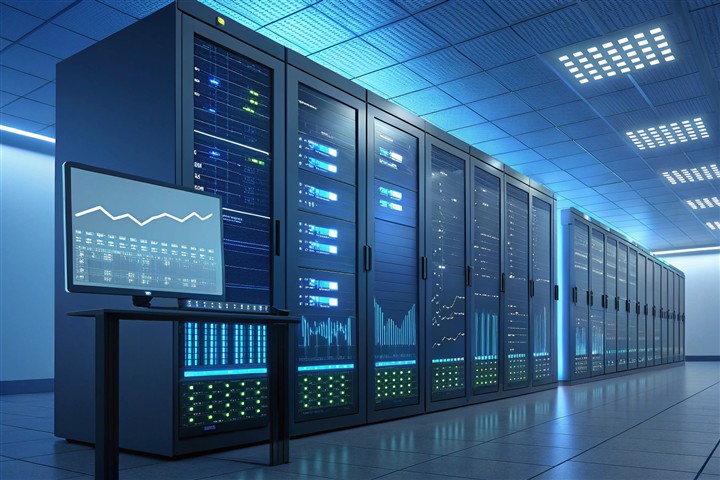
Over the past two years, AI infrastructure construction has focused mainly on GPUs, power supply and liquid cooling systems. However, as large-model training and AI inference continue to scale, the network is becoming the key factor affecting AI compute release. Cisco says the challenges brought by AI have extended from computing power to network architecture, with high-speed optical interconnect, metro networks and edge connectivity becoming the new focus of competition in the next phase of AI infrastructure.
In the past few years, the global AI industry has revolved almost entirely around GPUs.
From NVIDIA H100, B200 to GB200, and AI accelerator platforms from AMD, Intel and others, the industry has focused on how to obtain more GPUs and how to solve power supply and heat dissipation issues.
But as AI cluster scale keeps growing, a new challenge is emerging —network bandwidth is becoming a key factor affecting AI system performance.
During the 2026 Fiber Connect conference, Cisco Senior Business Development Manager Robin Olds said that the current development of AI is experiencing a turning point similar to the early days of the internet.
He said: "The impact of AI on the network is just like when the internet first appeared; we are standing at a new inflection point for the industry."
For data center operators, cloud service providers and network operators, the biggest challenge ahead is not just building more GPUs, but how to connect those GPUs efficiently.
Cisco revealed that AI business traffic now accounts for about 30% of total traffic on some backbone networks, compared to less than 1% two years ago.This change shows that AI has not only changed networks inside data centers, but also begun to reshape carrier backbone and metro network architectures.
Even more noteworthy, the next phase of AI traffic growth will come mainly from Agentic AI.
Unlike traditional chatbots, AI agents can continuously execute tasks, call applications and access external services, so network traffic is no longer short bursts but sustained, high-load data exchange.
This means future network planning cannot consider only peak traffic, but must also cope with the pressure of sustained high utilization.
For data centers, high-bandwidth, low-latency networks will become the standard configuration of AI infrastructure.
To address the new network requirements, Cisco has proposed the Agile Services Networking architecture.
Its core idea is to break down traditional network hierarchies, further integrating routing, optical networks and coherent optical communication technologies to reduce duplicate construction across different devices.
Through a unified network architecture, it is possible to achieve:
For data centers, this means more space can be used for deploying AI servers instead of network equipment itself.
From a structured cabling perspective, this trend also means future data center cabling systems must simultaneously adapt to new requirements such as high-speed optical networks, network convergence and modular deployment.
Beyond core data centers, the development of AI is also driving changes in edge computing architecture.Cisco believes that AI inference will increasingly be deployed closer to users.
Therefore, networks must not only connect large data centers, but also a large number of edge nodes.For example:
All these scenarios require local AI inference capability to reduce latency and improve response speed.
Cisco's new-generation unified edge platform integrates computing, networking and GPU resources into compact devices, supporting AI accelerator platforms from NVIDIA, AMD and Intel.
Its goal is to enable edge AI deployment and operation within a unified architecture.
As a result, a noteworthy new concept has emerged —Metro Edge.
In the past, enterprises usually accessed cloud services through multiple network tiers.In the future, more and more AI services will be deployed closer to users.
Cisco is driving the redesign of metro network topologies so that enterprises and users can access AI services through shorter paths.
This means:AI inference centers will become more distributed; the importance of metro networks keeps rising; the number of edge data centers continues to increase.
For the structured cabling industry, in addition to ultra-large data centers, high-speed optical networks will also spread rapidly among regional data centers, campus networks and edge nodes.
Compared with intra-data-center networks, people have paid less attention to the transmission networks connecting data centers and users.
Cisco believes this "Middle Mile" is becoming the new battleground for AI infrastructure.Robin Olds shared a case: one operator originally planned to upgrade its network from 10Gbps to 100Gbps, but ultimately jumped straight to 400Gbps.
However, shortly after the network was built, capacity was found insufficient for AI business growth, forcing further expansion.This case shows that AI traffic growth has far exceeded traditional network planning models.
In the future, carriers, internet companies and cloud platforms will all need to re-evaluate the pace of transmission network construction.
For the structured cabling industry, the biggest change brought by AI is not just network bandwidth upgrades.
The deeper change is that data center networks are evolving from traditional communication infrastructure into an important part of AI compute infrastructure.
In the coming years, data centers will continue to evolve in the following directions:
At the same time, as AI inference gradually extends to the edge, structured cabling applications will also expand from ultra-large data centers to smart buildings, smart campuses, industrial internet and more fields.
In the past, people generally believed that the core competitiveness of AI development lay in GPUs. However, as compute scale keeps expanding, the importance of the network is rising rapidly. From GPU interconnect inside data centers, to backbone and metro networks, and then to edge networks, AI is driving the entire network infrastructure into a comprehensive upgrade phase.
For the structured cabling industry, this means the industry focus will shift from traditional data transmission capability to high-speed optical interconnect architecture for the AI era. Whether it is 800G/1.6T optical networks, high-density fiber cabling, intelligent patch management, or new network connections between data centers and edge nodes, these will all become key directions for industry development in the coming years.
<p" style="box-sizing: border-box;">It is foreseeable</p"> that the competition for AI infrastructure is moving from "competing on GPU count" to "competing on network capability." In the future, what truly determines the overall performance of AI systems is not only compute chips, but also the high-speed networks connecting that compute. And structured cabling will gradually evolve from behind-the-scenes infrastructure into an important part of the digital foundation supporting the AI era.
Copyright © 2023-2025 APAC Cable (Guangzhou) Co., Ltd. All Rights Reserved 粤ICP备2025482347号-1
Address: No.361, Xintang Avenue West, Xintang Town, Zengcheng District, Guangzhou, China





 粤公网安备44011802001235号