


As intelligent computing, large-scale model training, and high-performance computing workloads continue to grow, data center networks are gradually evolving toward 400G high-speed interconnect. As a key component of network infrastructure, the 400G AI switch not only handles massive data exchange tasks, but also directly affects GPU cluster communication efficiency, network stability, and overall resource utilization.
Therefore, when planning a 400G network, switch selection should not focus solely on port speed or switching capacity. It requires comprehensive evaluation that also considers compute cluster scale, network architecture, workload characteristics, and future expansion plans. Reasonable equipment selection improves overall network performance while reducing later expansion costs, providing a long-term stable development foundation for the data center.

The performance of a 400G switch is determined by multiple key indicators, including port density, switching capacity, ASIC chip platform, and network optimization capabilities. These factors not only determine the performance of the device itself, but also directly affect the operating efficiency of the entire intelligent computing network.
Port density and switching capacity
Port density determines how many 400G interfaces a switch can provide, while switching capacity reflects the data throughput the device can handle. Together, the two determine the scale and scalability of network deployment.
Currently, mainstream 400G switches mainly include the following specifications:
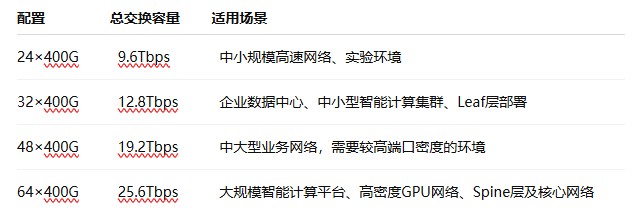
For smaller data centers, 32-port switches can usually meet server access and network expansion needs of a certain scale, while offering good investment efficiency.
As the number of GPU servers continues to grow, 64-port platforms can provide higher network aggregation capability, with clear advantages in reducing the number of switches, lowering network layer complexity, and improving overall bandwidth utilization, making them better suited for large-scale intelligent computing network construction.
Therefore, port specification selection should comprehensively consider the number of GPU servers, NIC configurations, network topology, and future expansion needs, rather than simply pursuing higher port counts.
ASIC (Application Specific Integrated Circuit) is the core of a switch data forwarding, and its architecture directly determines the data processing capability, forwarding efficiency, latency performance, and support for advanced network functions of the device.
Different ASIC platforms usually have different design positioning, and enterprises should evaluate them based on their own network ecosystems, business needs, and compatibility.
Currently, the more common ASIC platforms for 400G switches mainly include:
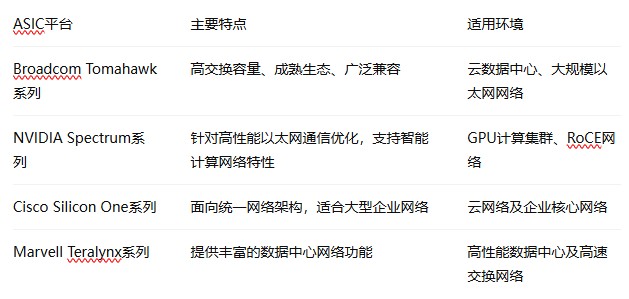
A superior ASIC platform not only provides stable line-rate forwarding, but also supports more complete congestion control, traffic scheduling, and network telemetry functions, providing a more stable network environment for intelligent computing workloads.
Intelligent computing workloads are usually accompanied by massive data synchronization and high-speed communication between GPUs, so networks need more complete traffic management mechanisms to reduce performance fluctuations caused by congestion.
Therefore, when selecting 400G switches, the following network capabilities should be the focus.
RoCEv2 support
RoCEv2 enables Remote Direct Memory Access (RDMA) over Ethernet, reducing CPU involvement in data transmission and improving data exchange efficiency between GPUs. It is one of the most important communication methods in current intelligent computing networks.
PFC (Priority Flow Control)
PFC implements flow control for data streams of specific priorities, reducing the probability of data loss during brief network congestion, making it better suited for workloads with high latency and stability requirements.
ECN (Explicit Congestion Notification)
ECN can notify endpoints to adjust their sending rates before severe network congestion occurs, making network traffic smoother and helping improve overall transmission efficiency.
Dynamic Load Balancing (DLB)
DLB can dynamically adjust traffic paths based on real-time link load, fully utilizing multiple link resources, reducing hot-spot links, and improving overall network throughput.
Network Telemetry
Telemetry functions can continuously collect network operating status, including port utilization, queue status, latency changes, and congestion information, providing reliable data support for network operations and performance optimization.
As intelligent computing clusters continue to grow, the above capabilities have become one of the important indicators for evaluating 400G switches.
Data centers of different scales have clearly different requirements for network equipment, and configurations should be made reasonably based on actual deployment needs.
For deployment environments with a relatively limited number of GPUs, networks usually adopt a Leaf-Spine architecture.
In such scenarios, 32×400G switches provide sufficient server access capability while reserving a certain proportion of uplink resources, meeting business growth needs while controlling construction costs.
If the cluster scale is expected to remain stable in the future, there is no need to over-provision higher-specification equipment.
When the number of GPU servers keeps increasing and networks need to carry large volumes of east-west communication traffic, higher port density and larger switching capacity become essential.
64×400G switches not only reduce network tiers and device counts, but also improve Spine layer interconnect capability, reserving more resources for future network expansion.
For data centers that need to continuously expand computing resources, such platforms usually have a longer lifecycle.
Switches at different network tiers have different responsibilities, so selection priorities also differ.
Leaf switches are mainly responsible for server access, and the focus should be on:
Spine switches handle a large amount of aggregation and forwarding, so the focus should be on:
Networks dedicated to GPU communication should focus on evaluating:
Backend networks place greater emphasis on stable, low-latency data exchange, so priority should be given to platforms with:
Switching platforms with such characteristics.
Data center networks typically have long service lives, so equipment selection should not only meet current needs, but also accommodate future business growth.
When formulating procurement plans, the following aspects can be key evaluation points:
If a 32-port switch can already meet business needs at this stage while retaining sufficient expansion margin, that solution can be prioritized to improve overall investment efficiency.
If a large number of new GPU nodes or additional inter-switch links are expected in the future, choosing a 64-port platform can reduce later equipment replacement and network reconfiguration work, providing greater flexibility for continued network evolution.
Selecting a 400G AI switch is a systematic task that requires comprehensive evaluation of network scale, computing resources, topology, and future development plans. Port density determines network access capability, switching capacity affects overall data throughput, the ASIC platform relates to device performance and feature support, and complete network optimization mechanisms determine the operational stability of intelligent computing workloads.
For data center construction, a reasonable switch configuration not only improves network performance, but also reduces the complexity of future expansion and strengthens the long-term sustainability of infrastructure. By planning scientifically based on actual business needs and building a 400G network with high performance, high reliability, and scalability, data centers can provide more stable and efficient network support for intelligent computing platforms.
Copyright © 2023-2025 APAC Cable (Guangzhou) Co., Ltd. All Rights Reserved 粤ICP备2025482347号-1
Address: No.361, Xintang Avenue West, Xintang Town, Zengcheng District, Guangzhou, China







 粤公网安备44011802001235号