


On November 6, 2025, the China-EU Business Summit was successfully held. Under the “Green Innovation, Open Cooperation and Win-Win” theme, more than 700 political and business leaders from China and Europe gathered in Shanghai to conduct in-depth exchanges and discussions on important topics including global industrial and supply chain synergy, frontier technology innovation, the digital economy, and green low-carbon industries, further deepening China-EU economic and trade cooperation.
Siemens Board Member and CEO of Smart Infrastructure Matthias Rebellius was invited to attend the conference and delivered a keynote on “Open Cooperation, Unleashing the Infinite Potential of Industrial AI”.
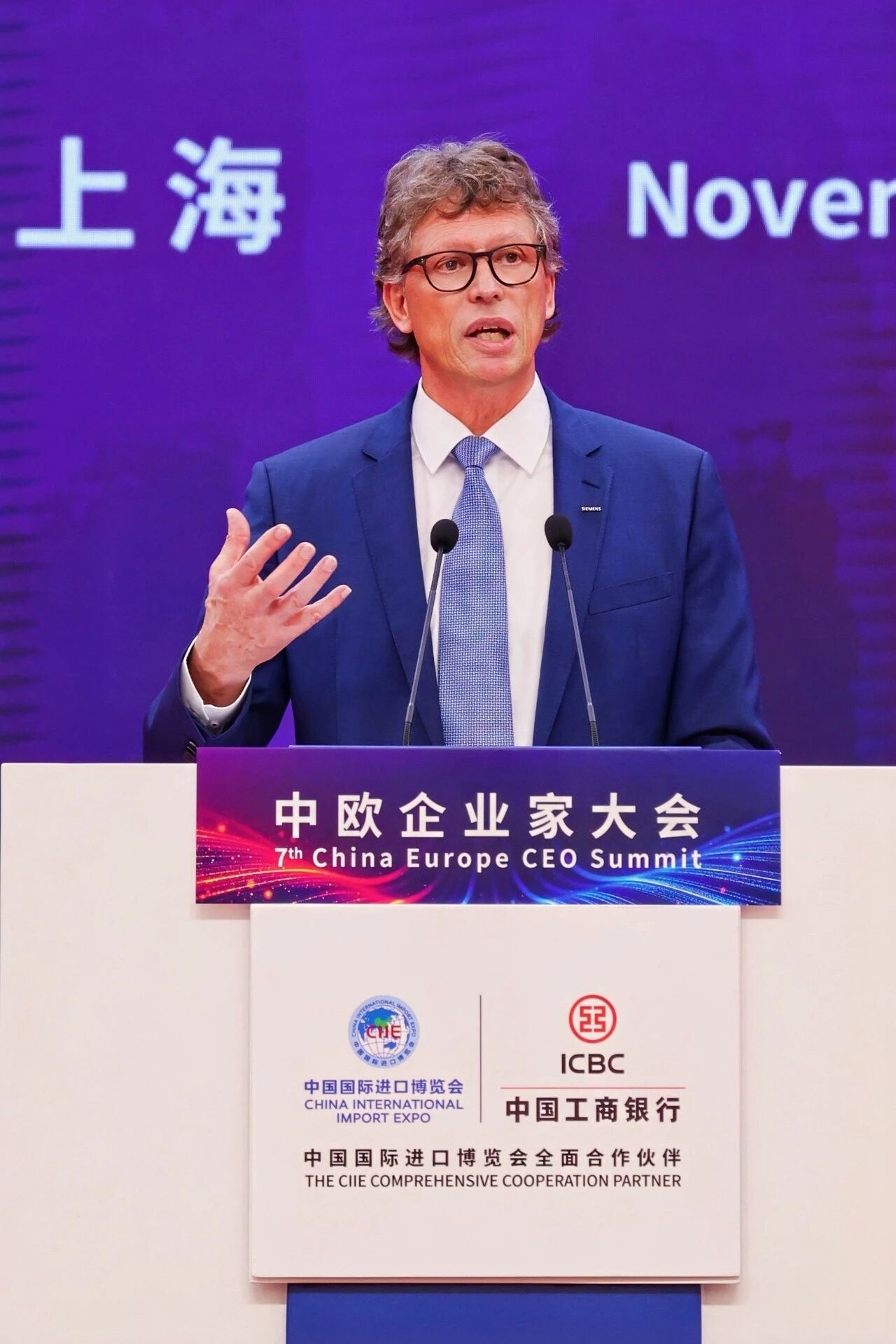
The following is a summary of the speech
This is my first time at the China International Import Expo. To be honest, I am deeply impressed — not only by the scale of the expo, the number of exhibitors, and the exhibits, but also by the vitality of the thriving business environment and the “anything is possible” spirit of pragmatic enterprisingness.
China is one of the most modernized economies in the world. It leads the world in embracing innovation and adapting with agility. Events like the CIIE show us the boundless opportunities we can seize together in today's rapidly advancing world of technology, and offer further inspiration:Through joint cooperation, we can create a more prosperous and more sustainable future.
China-EU trade is a perfect example. It has driven economic growth and technological innovation, and with the support of AI in particular, these innovations are helping us better integrate the real and digital worlds.
With the empowerment of AI, future industry and infrastructure will not only become smarter but will also operate autonomously without human intervention. Autonomous buildings will monitor space occupancy, weather forecasts, and energy prices, automatically adjusting relevant systems accordingly. Autonomous grids will automatically detect, locate, and isolate faults, and reschedule power supply within milliseconds. Autonomous production lines will flexibly orchestrate the entire manufacturing process, covering everything from logistics scheduling and equipment control to product sorting and assembly.
Siemens has been deeply engaged in the R&D and application of industrial AI for more than 50 years. We have over 1,500 AI experts and more than 3,700 AI patent applications. We have made significant progress in the secure sharing of data, the development of industrial foundation models, and the development and application of Industrial Copilot. More than 200 companies and over 150,000 engineers are already using Industrial Copilot, which enables people to converse with machines in natural language without programming. Industrial Copilot is also on call around the clock, supporting the setup, installation, and troubleshooting of machinery. Tasks that once took hours can now be completed in just minutes.
In China, we are actively helping to implement the “AI+” action, unleashing the enormous potential of industrial AI across all industries. Speaking of the profound impact of AI, let me share two specific examples.
The first is Rockmeson, a leading electrical products manufacturer in Shandong Province. With the strong AI analysis and prediction capabilities of the Siemens Smart ECX platform, Rockmeson has optimized the energy and carbon management of its factory, cutting nearly 600 tonnes of carbon emissions per year and achieving 100% carbon offset with renewable energy. Rockmeson has become Shandong Province's first zero-carbon smart factory.
The other example is Heying Data Technology Industrial Park, one of China's largest data center clusters. It uses integrated power modules composed of Siemens SIVACON low-voltage switchgear, shortening the project cycle by about 60%, reducing the footprint by 30% compared with traditional solutions, and greatly reducing the internal power distribution cabling inside the modules, effectively improving the PUE.
Since 1872, Siemens has partnered with China for more than 150 years.We will continue to deepen our roots in the Chinese market. But we know well: one person walks fast, but many people walk far. No single country or company can unlock AI's full potential alone. Only through hand-in-hand cooperation can we build an open ecosystem, exchange ideas, and co-create solutions.
By working hand in hand, we will move toward an even better tomorrow. In particular, AI will help us accelerate technology development and scaled application, making industry smarter, infrastructure greener, and our lives better.
Copyright © 2023-2025 APAC Cable (Guangzhou) Co., Ltd. All Rights Reserved 粤ICP备2025482347号-1
Address: No.361, Xintang Avenue West, Xintang Town, Zengcheng District, Guangzhou, China





 粤公网安备44011802001235号