


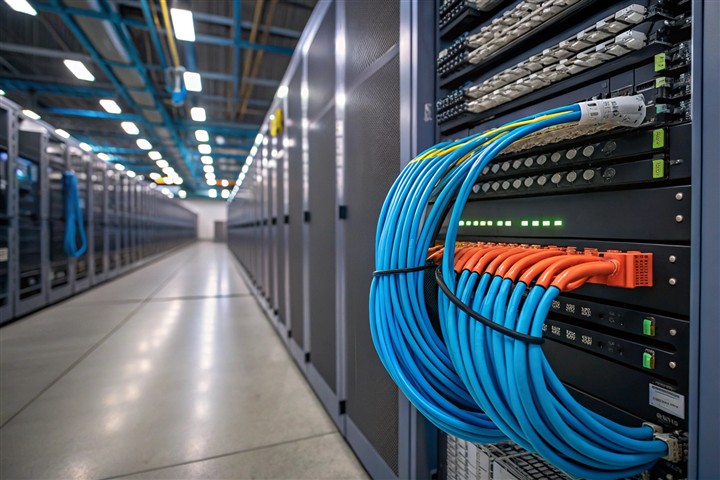
As AI training clusters continue to scale up, data centers are evolving from traditional computing centers into "AI factories". The rapid adoption of GPU clusters, high-density fiber cabling, liquid cooling, and ultra-high-power racks is not only reshaping data center infrastructure but also moving structured cabling and DCIM (Data Center Infrastructure Management) from behind the scenes to center stage as critical support for the stable operation of AI infrastructure.
The development of AI means more than just more servers — it is fundamentally changing how data centers are built, operated, and expanded.
Over the past decade or more, enterprise data center development has been relatively steady.
AI training and inference have completely shattered this balance.
Today, AI server racks commonly reach 50~100kW, some next-generation AI server platforms even exceed 120kW per rack, and these figures will keep rising.
The industry increasingly calls data centers "AI Factories", because they no longer merely provide computing resources — they continuously produce AI models and intelligent computing power.
In this context, any planning mistake, cabling error, or infrastructure bottleneck can directly affect the operating efficiency of an entire AI cluster.
Many people believe AI's biggest change comes from GPUs.
In fact, for the structured cabling industry, the biggest change is in network connections.
Traditional enterprise networks are dominated by north-south traffic.
In other words:users access servers;servers access the internet;and data exchange paths are relatively fixed.
AI training, however, is completely different.Tens of thousands of GPUs need to continuously synchronize parameters,and massive amounts of data need to be exchanged frequently between GPUs.Network traffic has therefore gradually evolved into "east-west" communication.
This means:
AI clusters today widely adopt 400G, 800G, or even higher-speed leaf-spine network architectures.Compared with traditional data centers, an AI data center may need to deploy nearly10 times more fibers.
Taking the NVIDIA GB200 NVL72 platform as an example, GPU, CPU, and storage network connections inside a single fully populated rack can require approximately 864 fiber strands.This far exceeds the design capabilities of traditional structured cabling systems.
Once fiber counts grow exponentially, the real challenge is not cabling but management.Many traditional data centers still rely on:
In ordinary enterprise networks, this approach can still hold up.But when faced with hundreds of thousands or even millions of fiber connections in an AI data center, such a management model is no longer viable.
For example:
A mislabeled backbone fiber;a patch connection not updated in time;a port connection record missed;any of these can cause performance degradation across an entire GPU training cluster.
For AI training, this is no longer a simple question of cabling tidiness, but a key factor that directly affects compute utilization and business continuity.
At the same time, excessively high cabling density can introduce new problems, including:
As a result,high-density structured cabling has evolved from an “installation problem ” into “ a continuous operations management problem ” .
Besides the surge in fiber counts, AI data centers face two additional infrastructure challenges.
The first is power supply.
Data center expansion in many parts of the world is already constrained by grid capacity.As AI compute demand grows rapidly, more and more data center operators are scrutinizing every rack, every power feed, and overall energy consumption.
The second is cooling.
Traditional air cooling is generally suitable for 20~30kW racks.AI servers, however, typically exceed this range.Liquid cooling and hybrid cooling are increasingly becoming the standard configuration for AI data centers.
At the same time, a large amount of new infrastructure has been added, including:
These systems are highly interconnected, further increasing the complexity of data center management.
In the past, DCIM was mostly understood as:
But in the AI era, DCIM's role has changed.It is becoming the real-time operations platform for the entire data center.
Modern DCIM needs to manage not only:
but also:
In other words, structured cabling systems have, for the first time, truly become an important part of DCIM.
Compared with traditional facility-centric management approaches, the new generation of DCIM focuses more on end-to-end mapping from services to networks and from logical topology to physical connections.
When fiber links, patching systems, power systems, and servers all reside in a unified data model, O&M personnel can quickly analyze the impact of any change, achieving true full-lifecycle management.
More and more data centers are adopting the digital twin concept.Here, a digital twin is not just a 3D model.More importantly, it is a digital operations platform that synchronizes with the physical environment in real time.
The platform continuously synchronizes:
This creates a unified digital mirror of the data center.On this basis, further capabilities can be realized:
Truly shifting from "reactive response" to "proactive prediction".
Copyright © 2023-2025 APAC Cable (Guangzhou) Co., Ltd. All Rights Reserved 粤ICP备2025482347号-1
Address: No.361, Xintang Avenue West, Xintang Town, Zengcheng District, Guangzhou, China





 粤公网安备44011802001235号